Today is World Mental Health Day and I have written this article to promote more discussion around innovative approaches to mental health.
In July my family and I returned to the UK after many years in Germany and, well, some things here are a little bit different to how the Germans do things.
At the beginning of September I received our water bill, which included a note that our water supplier – Anglian Water – also ran a text-message chat service for customers who were struggling a bit and needed someone to talk to. It didn’t have to be related to the water supply, they explained; you could talk about anything. This was probably the least German thing I had experienced since arriving back in the country! Well, like many people, I had feelings that I was struggling with. So I decided to give it a go.
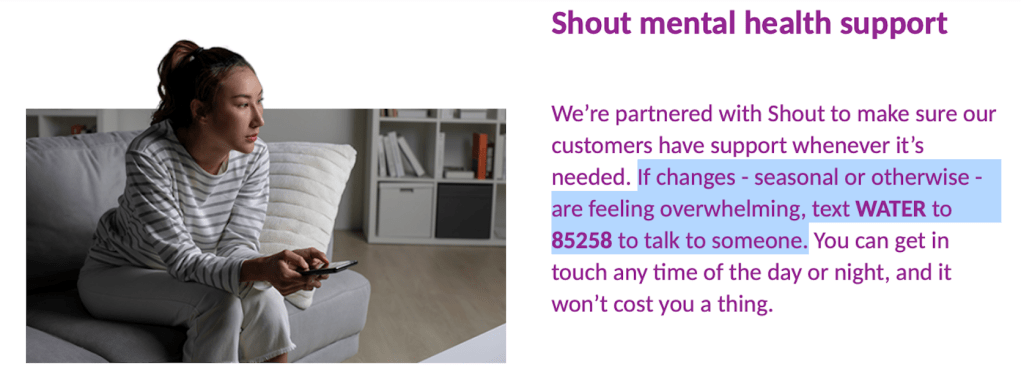
Screenshot from the email I received from Anglian Water in September
I type in the word “WATER”, hit send, and within seconds I receive four automated responses. First, a sort of welcome message, then a link to the organisation’s terms and conditions (the organisation is not Anglian Water) and that by using the service I consent to my data being processed. Then a rather nostalgic note that only messages under 160 characters can be processed (remember those days?!). And finally, a note about the company’s confidentiality policy and information that a volunteer is being sought for me. Then nothing for quite a while.
The charity that Anglian Water have partnered up with for this service is called Mental Health Innovations, who have been providing the free, 24/7 text-message chat service SHOUT since 2019. Currently the only such service in the country, trained volunteers provide conversations in order to support people struggling with their mental health. The charity is partly funded by donations, but it also enters into commercial partnerships with companies.
The partnership with Anglian Water has been in place for exactly two years; it was launched in 2023 on World Mental Health Day. As part of these commercial partnerships, a company purchases a specific keyword from Mental Health Innovations. In the case of Anglian Water, it is “WATER”. If you type the word “WATER” instead of “SHOUT”, the volunteers at Mental Health Innovations know that you are a customer of Anglian Water rather than just a member of the public.
In a phone call with a spokesperson from Anglian Water, I am told that this does not affect the quality of the service their customers are provided with. The volunteers provide exactly the same level of support as if “SHOUT” had been typed, and there is no obligation to talk about problems relating to your water bill.
Archie
I can confirm this. Although I have to give up after waiting 30 minutes on my first attempt, I have more luck with my second try, and after fifteen minutes a volunteer gets in touch. I exchange texts with ‘Archie’ for just under an hour, and at no point do we talk about water. I chat with him about my loneliness in this country following relocation, and about the difficulties we are having as a family settling in here. One thing I notice is that Archie tends to take around two minutes to reply. Mental Health Innovations says that clinical staff supervise their volunteers, so this might well explain these delays.
Archie uses active listening, coaching techniques and, above all, a great deal of praise and confirmation to allow me to feel that I can open up to him. He also recommends a podcast on mental health which I promise to try out. When he says goodbye, I actually feel a little better. And I miss him just a little bit. It felt good to talk to him about my feelings via text message sat on the sofa in my living room. Intimate, somehow.
It turns out that there are actually a few differences between texting “WATER” and texting “SHOUT”, as the Anglian Water spokesperson explains to me. Firstly, you may get through more quickly (although all calls are strictly triaged so that truly urgent cases are answered first). Secondly, certain data from these conversations is anonymised and made available to Anglian Water. As a result of this analysis, the spokesperson can tell me that in the two years since the campaign was launched, the emergency services have not been called out once for an Anglian Water client, and that only one case of suicidal thoughts has been documented. Call times and ‘success rates’ are also provided to the partner.
Thirdly, Mental Health Innovations volunteers are equipped with specific tips or signposts in case the topic of water bills does come up. This enables them to inform customers who are in financial distress about relevant ways to get help: for example, that they should check their eligibility for certain government subsidies, or look into how Anglian Water can help them pay in installments. Like other water suppliers, Anglian Water offers such support for customers who find themselves in financial difficulty.
In this sense, it seems to me that the volunteers at Mental Health Innovations act as a kind of augmented customer support team for Anglian Water.
How Anglian Water arrived at this decision
One big story around the water companies in recent years has been the pollution of the UK’s waterways and the rise of illegal sewage dumps, covered by news organisations such as the BBC and the Telegraph. This reached a head earlier this summer with a government-commissioned report recommending the abolition of the water regulator ‘Ofwat’ in a recognition that structural changes had to be made given these developments. This is the backdrop against which Anglian Water decided to launch its new mental health service in 2023.
The spokesperson explained to me on the phone how the company arrived at this initiative. During the cost-of-living crisis that followed the Covid-19 pandemic, Anglian Water trialled a customer support service via WhatsApp, which was well received. It turned out that many people preferred typing about their situation to speaking on the phone. Firstly, there is the convenience, but secondly people said they found it easier to express themselves in the (digital) written form than verbally. Thirdly, written communication can’t be overheard, so can be more discrete and private. Encouraged by the success of the WhatsApp customer service channel, Anglian Water decided to go one step further and launch the partnership with Mental Health Innovations.
East Anglia is a region characterised by poor mental health. The Anglian Water spokesperson tells me that prescriptions for antidepressants are nearly double the national average. Many villages, some of which are very remote, are prone to loneliness. But there is a second factor at play: the high proportion of properties purchased as second homes by wealthy individuals thins out the local population. In fact, official statistics show that North Norfolk has the second highest proportion of second homes in the UK after central London: almost one in every ten properties.
More than just corporate social responsibility
Some would argue that the decision to engage with a charity for a service like this is a classic case of a company engaging in corporate social responsibility (“CSR” for short). However, I don’t think that this is what is going on here. CSR typically involves a company donating money to a charity or carrying out fundraising itself on the charity’s behalf. This allows a company to promote itself for this work, but it doesn’t directly add value to the company’s products.
If this were traditional CSR, Anglian Water might have donated money to Mental Health Innovations and promoted their SHOUT service in their communications – but they would probably have done so using the term “SHOUT”. For me, the fact that they purchased a keyword from Mental Health Innovations means that something different is going on here.
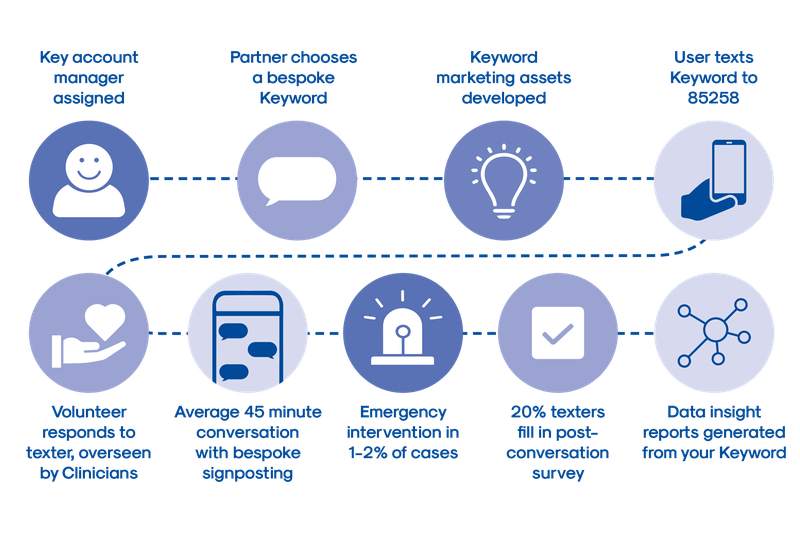
Diagram representing the process of a commercial partnership with Mental Health Innovations (Image reproduced with the kind permission of Mental Health Innovations.)
For me, there are two central questions here:
1. Why does a water supplier feel responsible for the mental health of its customers?
2. Why do mental-health-based commercial partnerships exist for these companies?
Regarding the first question: I believe this is primarily due to the normalisation of discourse on psychological health in many areas of British society: in culture, at work, and in the family. Don’t get me wrong: this is a good thing. And against this backdrop, I can imagine that it actually feels quite ‘normal’ for a company to take an interest in the mental well-being of its customers to a certain extent – indeed, you could turn it the other way round and ask how, in today’s world, a company could not care about its customers’ wellbeing? Perhaps it is the logical extension of taking your employees’ mental health seriously. It is also part of a broad shift towards prevention, and prevention can be done by many people in many different contexts – indeed: the more, the better.
The current cost-of-living crisis, which is causing more and more people to struggle to pay their electricity or water bills, is definitely leading to a rise in mental health issues. Some would argue that it is the job of the NHS to tackle these issues (or even of the politicians to fix the cost-of-living crisis in the first place). But of course, the NHS is also in crisis, with waiting times to see mental health specialists increasing. Hence the argument that it is better to offer people something now than do nothing and make them wait months for an appointment. This is one reason why services like SHOUT emerge, and I think it is one reason why companies like Anglian Water want to do their bit, as it were, to help their customers.
But this doesn’t answer the second question, because they could also just have supported SHOUT as SHOUT, without their own keyword. Perhaps the short answer here is that all charities need to fund their work, and donations can only go so far. But what we are dealing with here is a product, and therefore we need to talk about user experience.
Valuable Mental Health Trends
For some time now, product development has been about making things that customers love. It’s about the feelings a product evokes – not just the problems it solves. This approach is now well established, and companies that are good at it, such as Apple and Spotify, have become hugely successful.
The business of emotions is nothing new. What is new to me, however, is the way in which I feel that negative emotions, so to speak, are being dealt with here. The idea that mental illness might contain potential for value-creation, or to put it another way, that engaging with mental illness, rather than just positive emotions, might become part of companies’ ways of creating value.
With its other service, ‘The Mix’, which is aimed at young people specifically, Mental Health Innovations promises commercial partners “valuable youth mental health trends and key insights” (the company states that 75% of its audience is aged 16-25). One might ask what these trends are and why they should be of interest to companies. (I contacted Mental Health Innovations, but they have recently been very busy preparing for World Mental Health Day.)
What is also new, I believe, is the digital nature of these engagements, with text messages replacing phone calls, which makes the data analysis easier and faster. As we saw, Anglian Water realised that many customers themselves feel more comfortable with digital written engagement compared to speaking on the phone. But of course without this digitalisation, the data analysis would be far more costly and potentially not financially viable as a service. (Some mental health professionals might also point out that seriously working on your mental health is not always going to ‘feel comfortable’.)
Conclusion
On their website, Mental Health Innovations states that its service SHOUT has conducted three million text message conversations since launching, and that 43% of respondents said they had no one else to talk to. Clearly, people have a need for some sort of support.
I think it is a good thing that British society has come so far in terms of attitudes regarding mental health that such services are made use of. Countries like Germany could certainly learn a thing or two from the UK about normalising attitudes to mental health and campaigns that contribute to this. The fact that a company like Anglian Water is investing resources in offering such a service to its customers shows how far the discourse on mental health has normalised in the UK.
At the same time, I believe there is cause for concern about the direction in which the mental healthcare industry in the UK is heading. Firstly, there is a risk that professional medical care might increasingly rely on voluntary care and that the government could reduce state-financed capacity and resources, pointing to these cheaper resources and their popularity. That said, this is only a risk and not a certainty. But volunteer-staffed initiatives are not the only option here: the practice of social prescribing, for example, is another innovative approach that is much more integrated with existing medical care provision.
Secondly, one might ask why mental health trends are of such interest to companies and what kind of products they want to develop using them. In terms of the keyword partnerships themselves, since these are no longer a matter of CSR, but rather of selling a product, a space may open up for becoming more creative in terms of what that product can be and how much value it can deliver. As long as Mental Health Innovations is the only organisation providing this service, there isn’t a market to speak of, and so there is little external pressure to experiment. But if the model proves successful, Mental Health Innovations may well soon face competition, and then we could well see a new dynamic emerge.
 Notes from Norwich // Notizen aus Norwich
Leave a comment